
NOTE: Cet article est également disponible en français.
After the music industry and the movie industry, it is the turn of the publishing industry to be scared of the internet. The reason? Google’s monumental scanning project announced last year, Google Print. The first two industries were, and still are, scared of illegal filesharers. So-called piracy is not really what the publishing industry is afraid of right now, but this industry shares with the others a fundamental trait: a complete, utter misunderstanding of technology, high-tech companies, and what those can actually bring to their own business - possibly at the price of a change in business model.
Case in point, music. For years now, the Recording Industry Association of America (RIAA), previously better known for an equalization curve for long play records, has been quite unsuccessfully fighting music filesharing on the internet. The truth of course is that it is extremely easy to exchange music files over the internet, and therefore hard to stop the trend, even if a few lawsuits may temporarily slow down the rate of filesharing. In addition, many doubt that fighting your customers or potential customers is a good business proposition.
But is it that hard to curb illegal filesharing? Not if you tackle the problem from the right angle. In 2003 came Apple and its iTunes Music Store, the first online music store offering legal downloads of songs or albums by the unit. The result: half a billion songs sold for $0.99 each in the two years since the opening of the service, with most of the revenue going to the record companies. The trend is accelerating and Apple expects another half a billion songs to sell by December 2005, and an additional billion by May 2006. The morale of the story: if record companies had spent their energy figuring out and implementing a business model adapted to the internet, they would have curbed illegal filesharing, sold billions of songs by now, and made a huge profit. Instead, they have wasted the money legitimate buyers gave them by suing grandmothers and little girls.
A similar situation is in the works today with Google and the publishing industry. Google’s project consists in scanning up to 15 million books over a few years. Among those, not only out of copyright works, but also works still covered by copyright. However, Google plans to follow fair use laws regarding use of the material. Beyond being a wonderfully exciting project that promises to bring much forgotten knowledge right to your browser, this project also promises publishers that people will buy more books because they are able to figure out quickly whether a book is interesting to them or not.
But instead, the Association of American Publishers (AAP) is suing Google, our of sheer unreasoned fear. Never mind fair use. Never mind the incredible benefit of the service to students, researchers, and casual readers around the world. Never mind the potential for increased sales. Never mind that publishers can easily opt out of Google Print (a favor done to them by Google). Never mind, in the end, the point of Google Print. They are just suing.
Unreasoned critics of the Google scanning project abound. I mentioned earlier in this blog the blog-style ramblings of Michael Gorman, president-elect of the American Library Association. I also talked about Jean-Noël Jeanneney’s book, “When Google Challenges Europe”, a not-so-bad initial thesis followed by quite bad implementation ideas. More recently, I read in L’Hebdo, a Swiss weekly magazine, an article entitled “The Race for the Big Digital Library has Started” (“La course à la grande bibliothèque numérique a démarré”). The article contains good and bad, but unfortunately gives too much space for the comments of a few clueless people, in particular:
Alain Jacquesson, director of Geneva’s Public University Library (BPU) of Geneva, thinks the project is in the end going to be a great tool, but then places a Gorman-esque, Jeanneney-esque comment: “Who will read hundreds of pages on screen?” Don’t they have printers at BPU? Can’t they see that in just a few years, electronic paper will be widespread and make reading electronic documents much more convenient? Doesn’t all the knowledge those librarians should have by being specialists of their domain give them at least a minuscule hint as to what the future of electronic information may be?
Danielle Mincio, curator of the manuscripts at Lausanne’s Cantonal University Library, says: “The documents will be drowned in the mass.” She doesn’t realize of course that this is exactly where Google’s core business lies, and what has made them the most successful search engine on the web for years now: the fact that they have so far been the best at ranking search results. They also have some of the brightest minds on board who are, no doubt, working hard to improve search algorithms. Also, how is the current system of quite awful library catalogs better than a full-text content search?
Jean-Frederic Jauslin, director of the Swiss Federal Office of Culture (and once director of the Swiss National Library), says: “It’s not because a mass of information is available that it will be used and that it will make people smarter.” This has got to make you think. Such a comment may have been taken terribly out of context by L’Hebdo, but for the moment I feel ashamed that my country’s culture is in the hands of Mr. Jauslin. Who has ever claimed that the goal of Google Print was to make people smarter? Doesn’t Mr. Jauslin think that a slightly subtler analyis of the possibilities Google Print, or large scanning projects in general, could be made?
The L’Hebdo article ends on an insightful note: that libraries, “not accustomed to competition, have however in their hands a formidable occasion to show their usefulness, in a time where relevant information is worth gold.”
The morale of the AAP lawsuit and the L’Hebdo article is threefold:
- Lack of imagination and lack of understanding of the prospects of technology are widespread among people who should be specialists of their domain (namely librarians) and always on the lookout for the latest possibilities.
- Some people in charge of libraries in the US and Switzerland appear more eager to keep their jobs than to actually think about providing a service which will be useful to the next generation. Kudos on the other hand to the libraries at Michigan, Stanford, Oxford, New York and Harvard that have partnered with Google.
- Europe is very late in this game. The reason is not so much a lack of political will to start such a project, as per Mr. Jeanneney’s stance, than an climate which is unfriendly to the development of the computer industry, in particular the software industry. Among the reasons for this situation: the sad fact that Europe does not encourage its citizens to innovate by starting up their own companies. Instead of raising and subsequently wasting public funds to start a sort of European Google Print, Europe should seriously think about the reason why Google, the company, was born and is now thriving in the US and not in Europe.
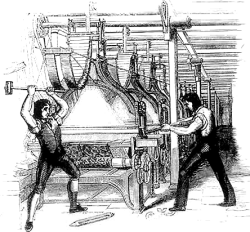
Luckily many people are striving to be creative and to ease access to information. It is to be hoped that the AAP will just waste its dollars in its lawsuits, that Google will be able to continue its Print project, and that the Luddites will lose again.
Comments powered by Disqus.